How Building a Baking App Taught Me Something New About Sourdough
When I decided to build a bulk fermentation tracking app the purpose was twofold:
- Make timing of stretch and folds, and bulk fermentation easier to track.
- Learn more about AI and how it can help with coding.
2026 will be my 30th year as a professional software developer and the constant theme throughout my career has been the need to continuously learn new skills. In the early days it was C++ and Java, then Ruby and Rails. Nowadays, whether you like it or not, you have to learn how to use AI as a tool — and I was behind in my learning.
That’s when I decided one weekend to dive straight in and see what I could achieve with AI, specifically Claude Code. I am not a mobile developer but have novice level experience of it, so I felt it would be a good test to develop a mobile app from scratch using only AI prompts. I was shocked by what I could ship by the end of the weekend — a fully functional app (that still needed some polishing) and a marketing website to boot.
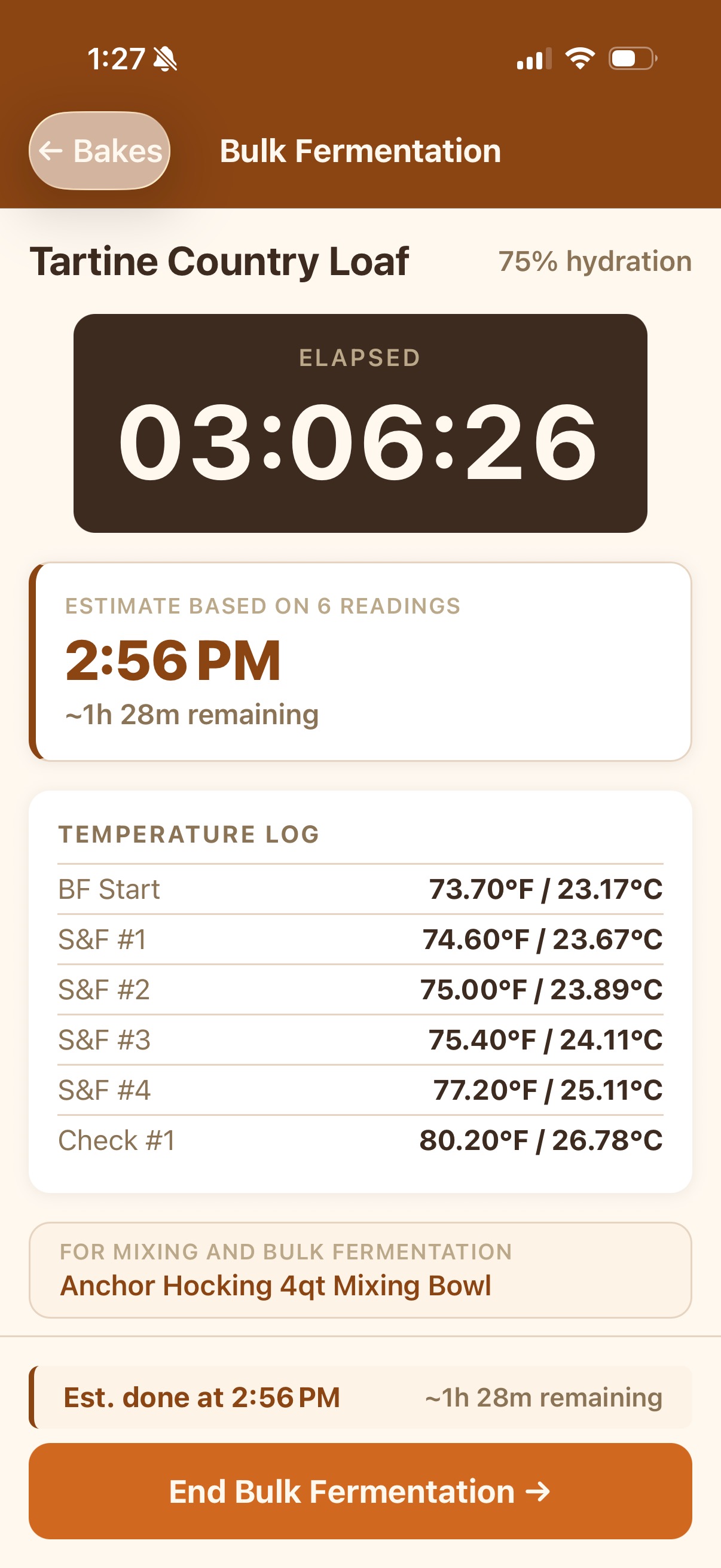


What really surprised me, however, was that I learned something completely new about baking sourdough. I want to be clear — I don’t know everything about sourdough baking. Far from it. I’m a weekend baker at most. The surprise was that after reading quite a few books on sourdough, when I prompted the AI with the requirements of the app I wanted to create — the ability to input a recipe, set timers, measure temperature, and extrapolate when bulk fermentation is done — the AI introduced me to a known biological method of estimating fermentation completion: the Q10 temperature coefficient.
In simple terms, Q10 describes how the rate of a biological process changes with temperature. For sourdough, it means that for every 10°C rise in dough temperature, fermentation happens roughly twice as fast. It’s a well established principle in biology that I had simply never encountered — and likely never would have, since I never studied the subject.
Since I never studied biology, Q10 was something I most likely would never have come across on my own. No sourdough book I had read mentioned it by name, yet here was AI surfacing a precise scientific principle that made my app genuinely more useful.
I don’t know where I sit with AI yet. I am very fearful of the blind march towards adoption without a plan for what happens if it puts masses of people out of work. However, this was a very pleasant learning moment for me — a reminder that these tools can expand what we know, not just speed up what we already do. That experience goes firmly in the pro column.